


GTIN Frequently Asked Questions
GS1 is the global standards body for item identification. Each country has its own local office that administers the licensing of Company Prefixes and GTINs. In the US, the local GS1 office is called GS1 US. Even though GS1 US is technically a monopoly, the GS1 system does provide trading partners the assurance of globally unique item identifiers. It is for this reason that retailers and marketplaces, such as Amazon, require suppliers to obtain GS1 UPC barcodes.
No. GS1 US only provides the identifiers (GTINs to build the numeric Universal Product Code. Unfortunately, many new companies incorrectly associate a barcode with a UPC, so the GS1 sites use ‘Apply for Barcode” and this often causes confusion. 
GTIN.Cloud is a global UPC product data repository plus management portal used to assign GTINs and create .eps barcodes. Unlike other databases, the GTIN.Cloud repository enables companies to export all of their GTINs to other registries (i.e. Amazon, Google, DataHub) without any additional fees. Furtrhermore, an assigned GS1 Barcode Consultant personally validates both assignment and UPC product data before publishing.
The DataHub is a basic tool included with a GS1 licensing membership and can manage GTIN assignments. It is important to note that the DataHub does not actually publish or promote products to trading partners, but is a repository for storing GTIN assignments and product data. Also, basic access to the DataHub is limited and does not allow members to download GTINs and Case Barcodes (GTIN-14) without an upgraded membership ($4500). Unlike DataHub, GTIN.Cloud creates the .eps barcode files and allows companies to export all their data to any other registry. In addition, there is no validation by a consultant to ensure data s correctly provided. The GTIN.Cloud data can be exported into DataHub but DataHub does not allow all GTIN data to be exported out of the registry. For additional information, please call 888-540-6885 or visit GS1 Barcode Service.
GTINs have different statuses and data can easily be amended in “Draft” states. Once a GTIN is “In Use” there are certain attributes that can be changed. GS1 consultants can assist with these type of instances.
This is commonly done to correct typographical errors and strategy changes. The Brand Name can be changed for a “In Use” product. Based on the impact of the change for your trading partners, you may want to consider issuing a new GTIN. Please note that the trade item will use up an available GTIN.
If a product has an “In Use” status on the GS1 DataHub, a new GTIN is required to be assigned for any change in net content.
Aside from assigning company prefixes, the GS1 creates the global standards for item and logistical barcoding. The GS1 General Specification covers all the rules for allocating numbers. As of January 2019, GS1 guidelines do not allow for UPC (GTIN) reuse. Click Here To Learn More.
The first digit of a GTIN-14 is called an “indicator digit” and is only found in case identification. If another case that contains the same trade item is created, the new GTIN-14 will start with an indicator digit of “2” and so on. GTIN-14s can have indicator digits up to the “8”.
UPC (GTIN) identification is used by a variety of industries and in some cases there may be minor alterations and requirements associated with barcode marking. For example, certain states have specific requirements for expanded product data for CBD products.
The acronym GTIN stands for Global Trade Item Number. A GTIN is used by a company to uniquely identify all of its trade items. A trade item is defined as products or services that are priced, ordered, or invoiced at any point in the supply chain. Prior to 2005, different countries used similar but different standardized product identifiers. In the US, the identifier was a 12-digit number called a UPC. Europe and Japan used 13 digit identifiers called EAN and JAN, respectively. They followed a common structure including a company identifier, a product number and a check digit. Consequently, a GTIN is essentially an umbrella term used for identifiers previously called UPCs, EANs or JANs.
When UPCs and EANs were first introduced, the underlying databases were limited to 12-13 digits for the UPC/EAN/JAN. The issue was that EAN/JANs from non-North American companies, could not be read by most US scanners. In addition, warehouse-type retailers started selling full case products which carried a 14 digit ITF-14 (case code). Consequently, it was determined that the GTIN data field should always have 14 digits and identifiers with less than 14 digits can be padded with left zeros (ie. UPC 012345678905 would be saved in a GTIN-14 data format of 00012345678905.)
Since the UPC (Universal Product Code) was by definition “universal”, the evolution to GTINs had very little impact with US companies who had products marked with UPC barcodes. Their barcodes were already capable of being scanned by POS scanners around the globe. Before the Sunrise 2005 GTIN adaption (see below) was established non-North American companies would be required to have packaging just for the North American market with a UPC because the US POS scanners were not capable of reading the 13 digits of an EAN (or JAN) barcode. This caused enormous costs and confusion for companies selling products globally.
Originally, the US UPC standards organization was called UCC (Uniform Code Council). They administered UPC Company Prefixes and managed the identification guidelines. Each country had its own similar organization providing similar functions. Due to nuances in measurement and local guidelines, the identification standards were not completely identical amongst all of the standards organizations. GS1 global office was created to harmonize all of the local UPC/EAN identification guidelines and administer global GS1 Company Prefixes. Each country now has its own GS1 local office that now licenses these prefixes and promotes the global standard. The Uniform Code Council effectively became GS1 US.
A GS1 Company Prefix essentially has a padded left zero added to the UPC Company Prefix. So UPC Company Prefix 012345 would have a GS1 Company Prefix of 0012345.
No! By definition the 12 digit UPC is “universal” and has always been able to be read worldwide. Non-North American companies only need to identify their products with an EAN(or JAN) barcode since every store in the US can now read 13-digits.
Note: There are numerous 3rd party websites offering discount UPCs (aka UPC resellers). When a company offers to provide BOTH a UPC and EAN, it should be a flag that they are not versed in the global standards. Buyer Beware!
Companies (brands) should license their Company Prefix and/or GTINS from their local GS1 office. To learn more about the steps needed to obtain a barcode, please visit www.gs1-us.info.
Background: GTIN Sunrise 2005
GTIN Sunrise 2005 was an industry initiative established by GS1 US (formerly the Uniform Code Council) which mandated that as of January 1st 2005, all North American retailers and trading partners that scan Universal Product Codes (UPC) should have expanded the data structures associated with the UPC to a 13-digit field length to process EAN-13 symbols. Additionally, GS1 US recommended that all manufacturers, retailers, and distributors update and expand their databases and applications to accept 14-digit data structures. These data structures will support the Global Trade Item Number (GTIN), allowing complete item identification of using a GS1 data carrier to support efficient and seamless global trade.
13-digits vs. 14-digits

The GTIN Sunrise 2005 initiative was focused on creating a compliant environment for scanning and processing EAN-13 and EAN-8 codes in addition to the 12-digit UPC symbols currently scanned at point-of-sale in North America . While the initiative does not explicitly state inclusion of 14-digit data structures, it recommended that all parties who upgraded their systems for Sunrise 2005 compliance take the additional steps to make their systems compliant with the GTIN. In addition, upgrading systems for GTIN compliance allows scanning of all levels of packaging (ITF-14, or case codes, can be processed) as well as emergent technologies such as GS1 Databar.
The GTIN Sunrise 2005 Impact on Companies
- Companies/Brands – Any organization or manufacturer who assigned product numbers for trade items or services needed to be aware of the new guidelines to ensure compliance with trading partners and suppliers.
- Barcode Originators/Printers – Packagers, commercial printers, and graphics and layout specialists needed to be aware for the new guidelines to ensure compliance for their customers.
- Those that USE UPC/EAN barcodes – Retailers, distributors, or any receivers of trade items (which may also include manufacturers and suppliers) needed to be aware of the new guidelines to ensure their own systems are compliant.
Where do companies go to purchase GTINs aka UPC Codes?
Companies can license GTINs (UPC and EAN barcodes) directly through GS1 US, or work with an authorized GS1 channel partner such as Bar Code Graphics for licensing help plus print-ready barcode files. The short video below walks through the process.
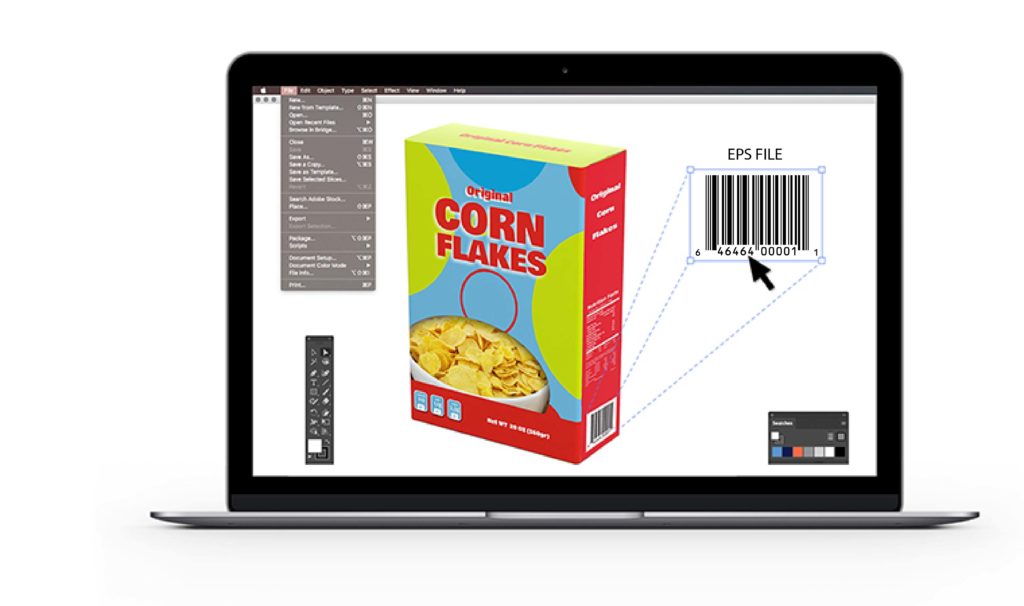
Create Print-Ready Digital .EPS Barcode Files 24/7
A crucial component of precise digital barcode artwork is “bar width adjustment” (BWA), which compensates for gain/reduction occurring in the printing processes. A barcode image file which does not account for BWA will not print accurately for most print technologies. Createbarcode.com is the only GS1 Certified solution to create print-ready digital barcode images.
