

How UPC Codes Relate to GTINs & UPC barcodes
The term “UPC Code” is part of the American vocabulary. Still, it technically doesn’t mean what most people think it does. There are many terms and acronyms used to define the black-and-white symbols included on almost every product. Words such as; UPC, barcode, UPC Code, UPC barcode, SKU, UPC-A, and GTIN, are commonly used interchangeably and incorrectly.
Standardized barcode identification began in the early 1970’s and proliferated throughout various retail sectors, from grocery stores to general retail outlets. The explosive growth of e-commerce, driven by giants such as Amazon and Walmart, has magnified the importance of standardized barcode identification. Product tracking, inventory management, and sales processing are reliant on this concept. The information below will help clarify many misunderstandings, and also provide guidance on how to correctly identify products with global standardized barcodes.
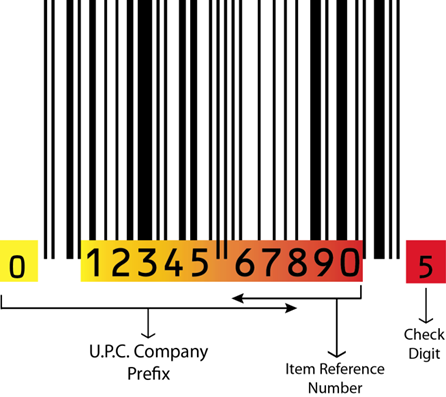
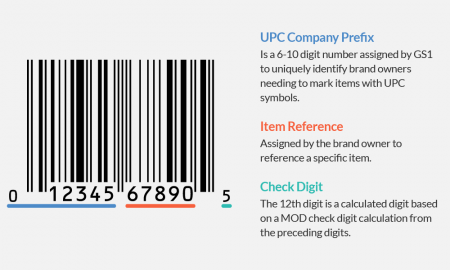
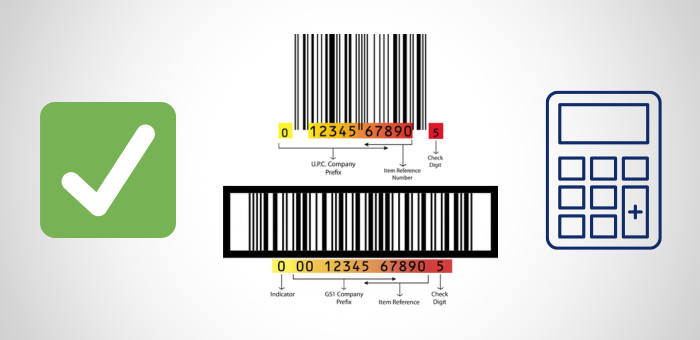
The first six to nine digits of a UPC are referred to as the “Company Prefix”, and they are assigned by a non-profit organization (GS1 US formerly the Uniform Code Council). This number uniquely identifies a company and always remains constant on all of a company’s products. The next set of digits is called the “product numbers.” Product numbers uniquely identify individual items. Unlike the GS1 Company Prefix, product numbers are arbitrarily assigned by each company. The twelfth character is called the “check digit”. Using some form of check digit generator (use our free check digit calculator) this digit is calculated using a mathematical calculation based on the first 11 digits of the UPC code.
A common mistake companies make is creating their own UPC numbers. A company cannot “make up” its own UPC number. To have a UPC code that will scan at Point of Sale, the UPC number must contain a GS1-assigned Company Prefix, also known as a manufacturer prefix. GS1 is the global standards organization for item/shipment identification and administers the assignment of GS1 Company Prefixes.
What is a UPC Code?
The acronym, UPC, stands for Universal Product Code. Consequently, the phrase UPC Code is redundant (Universal Product Code Code). However, due to the term’s popularity and mass misunderstanding, it is unlikely to change any time soon. That being said, a Universal Product Code is a numeric 12-digit identifier that is based on a global standardized structure.
A UPC code is pivotal for both small and large businesses in bringing their products to market. Essential items, including food, coffee, home goods, and apparel, all depend on these barcodes for streamlined distribution and sales. The global standard is managed by an international body called GS1. GS1 and their local country offices do not make barcodes, but create the identification guidelines and administer the licensing of standardized identifiers. As described on this website, a GTIN (Global Trade Item Number) is the umbrella term for this global product identifier, and a UPC is a form of a GTIN.
The Difference Between a UPC & UPC Barcode
Barcode symbols are referred to as “data carriers”. There are numerous types of barcode languages, and UPC-A coincidentally happens to also be the name of the most popular barcode language. Unlike a QR Code, which can encode web addresses, raw data, and contact information, the UPC-A barcode can only encode 12 numeric digits.
The UPC (aka UPC code) is the actual 12-digit identifier and the UPC-A barcode encodes the data. In the example to the right, the UPC data “012345678905′ is encoded in the UPC-A barcode.
Barcode US helps connect your items’ product data to unique UPCs (GTIN-12s) and provides the actual UPC barcodes, that enable businesses to sell their products globally. With Barcode US, your entrepreneurial idea can blossom and scale into a thriving global enterprise. When scanned, the UPC data (GTIN-12) allows point-of-sale systems to accurately retrieve the item’s details, ensuring efficient and reliable transaction processing. This system not only streamlines sales and inventory management, but also supports accurate pricing and product tracking throughout the retail industry.
How To Get UPCs and UPC Barcodes
| License Prefix for 10 Barcodes | License Prefix for 100 Barcodes | ||
|---|---|---|---|
| Starting at $70 | Total Fee: $400 | Total Fee: $1,000 | |
| Apply Now | Apply Now | Apply Now | |
| Unique Product Identifier(s) | ✔ | 10 GTINs | 100 GTINs |
| Digital .EPS Barcode(s) | ✔ | 10 Barcodes | 100 Barcodes |
| Access to GTIN.cloud® | ✔ | ✔ | ✔ |
| Official GS1 Certificate | ✔ | ✔ | ✔ |
| Data Validation | ✔ | ✔ | ✔ |
| Annual Renewal Fee | ✘ | ✔ | ✔ |
| Supports Cartons & Pallets | ✘ | ✔ | ✔ |
| Enables Couponing | ✘ | ✔ | ✔ |
| Identify Medical Devices | ✘ | ✔ | ✔ |
| Apply Now | Apply Now | Apply Now |
UPC Code vs. SKU vs. Part Number
As indicated above, a UPC Code is a global standardized 12-digit number used to identify items. The benefit of a standardized identifier is that trading partners around the globe can trust and use the same UPC (GTIN-12) to recognize your products. This is why proper UPC product identification is crucial.
Two common identifiers used within specific environments are an SKU (Stock Keeping Unit) and a manufacturer’s part number. An SKU is an internal identifier used by individual retailers. It enables retailers to track sales data and inventory associated with the manufacturer’s UPC code. In certain situations, a retailer may rely on different UPC codes, but they can assign an SKU for that product type to keep track of all the barcodes associated with that item. For example, a pair of gloves that a retailer sells can have a different UPC for every color and size variation, and to properly track all the various UPCs, the retailer creates one unique SKU number. Two retailers can sell the same item with the same UPC codes, but they will both use their own internal SKU number.
Some manufacturers also maintain separate product numbers for their products. Each internal operating environment may vary and certain systems rely on their own identifiers. Companies do not have to match their own product numbers to the same as the item reference numbers within a UPC code (GTIN-12).
Do I need A UPC Code?
Identifying items with UPC codes is completely voluntary, and there are no legal requirements to use them. It is important to note that your products will most likely not be accepted at most retailers and online marketplaces. Even if you are selling products solely on your own website, if you hope to get high rankings on Google, you will be asked to include a UPC (GTIN-12) when listing your products.
In today’s marketplaces, UPCs will help you keep track of sales for your products and allow you to sell your products anywhere. In addition, the Company Prefix GTIN data for items also corresponds to identification standards involving case packaging, shipping labels, and even manufacturers’ coupons.
The Importance of Doing it Correctly
Without an authentic UPC code licensed to your company, selling and tracking your goods through the global supply chain is not possible. For most retailers (including Walmart, Home Depot, Kroger, Whole Foods and Amazon) having a correctly licensed UPC code on your product is a requirement to sell it. The internet is full of misinformation and unauthorized discount UPC resellers.
Basic Overview of UPC Barcodes
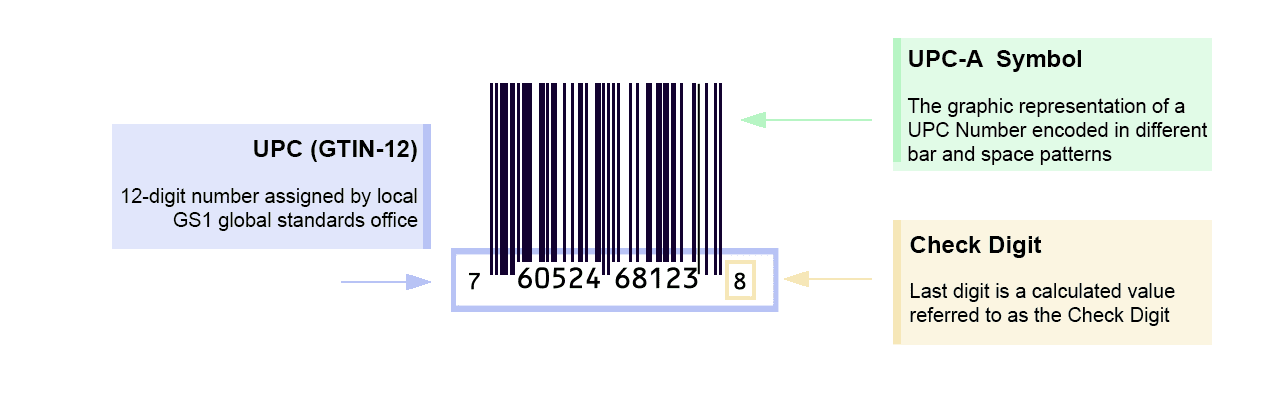
The Universal Product Code (UPC) is a 12-digit identifier assigned to trade items in North America for buying and selling purposes. Each unique variation of a product, such as different sizes or colors, is assigned its own distinct UPC. A UPC barcode is a one-dimensional, machine-readable symbol that visually represents this identifier. The UPC-A format specifically encodes the 12 digits into a pattern of bars and spaces that scanners can easily interpret.
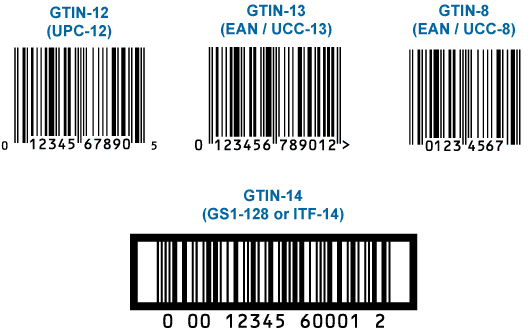
UPC-12 = GTIN-12
The UPC, also known as UPC-12, is essentially a GTIN-12, a globally recognized product identifier. To ensure compatibility with databases that require uniform lengths for all GTIN formats, the 12-digit UPC is padded with leading zeros, typically “00,” to create a 14-digit GTIN. This transformation maintains the integrity of the original identifier while enabling seamless integration with systems designed to handle GTIN-14 standards, ensuring accurate product identification and data management across global supply chains.
Obtaining GTINs and Barcodes
The method you choose to obtain barcodes for your products will depend on where you plan to sell them. GTINs can be acquired directly from the global standards organization, purchased through a third-party UPC reseller, or assigned internally within your company. Consider the following guidelines to determine the best source, keeping in mind the specific purpose of the UPC and the requirements of your trading partners.
Most national retailers, including Amazon, Wal Mart, Kroger, Target, The Home Depot and several others explicitly direct suppliers to get UPC (GTINs) licensed by GS1 and prohibit the use of UPCs obtained from UPC resellers.
Refer to this table to determine available options for obtaining UPC barcodes:
| UPC used for: | GS1 | UPC Resellers | Internally Assigned |
|---|---|---|---|
| UPCs for use on Amazon Vendor Central or Amazon Seller Central. | ✔ | ✘ | ✘ |
| UPC Number registered with the GS1 and available to retailers and trading partners via GTIN.cloud. | ✔ | ✘ | ✘ |
| Items being sold by local stores and small regional retailers. | ✔ | ✔ | ✘ |
| Items being sold to a distributor. | ✔ | ✔ | ✘ |
| iTunes, CDs or music titles. | ✔ | ✔ | ✘ |
| Items being sold on your own website, or used internally to support accounting. | ✔ | ✔ | ✔ |
| Items being sold by large national retailers such as Walmart, Kroger, The Home Depot, and Amazon. | ✔ | ✘ | ✘ |
| Apply Now! | Learn More |
GS1 Global Standards
The safest and recommended way to get barcodes is through GS1 barcode service, which includes GTINs licensed to your company (brand). GS1 is the global standards organization that governs Global Barcode Specifications and administers licensing of unique identifiers. The local GS1 office offers individual GTIN assignments and Company Prefixes for blocks of GTIN identifiers, depending on how many are needed.
Benefits of using GS1 GTINs
- GS1 licensed GTINs are acceptable at any retailer around the globe.
- UPC barcodes licensed by GS1 are registered to your company (brand)
- Retailers and marketplaces (Amazon) use tools, such as GTIN.cloud and Verified by GS1 to authenticate GTIN ownership.
- GS1 offers paid certifications and classes enabling companies to understand GTIN barcode requirements.
Disadvantages of GS1 GTINs
- The fee for obtaining GS1 GTINs and Prefixes is based on the total number of unique items requiring barcodes and can be expensive.
- Companies with Company Prefixes for 10 or more GTINs are required to pay an annual renewal fee for continued Prefix Licensing.
- Complex registration and GTIN management processes.
- Basic GS1 licensing fees do not include GTIN support, so additional GS1 Barcode Support subscriptions are required, if companies do not invest in certification classes.
Since GS1 does not provide the actual certified print-ready digital barcodes nor support, members either need to subscribe to GS1 Barcode Support programs (barcodes provided) or use UCC/GS1 certified software to generate .eps barcodes (createbarcodes.com).
3rd Party UPC Resellers
UPC Resellers are privately owned for profit companies that sell UPC Numbers which were originally assigned by the Uniform Code Council (UCC) before 2001. These companies are not regulated so prospective buyers need to assess the legitimacy of the offering and if they safeguards to protect their assignments.
Most national retailers, including Amazon, Wal Mart, Kroger, Target, The Home Depot and several others explicitly prohibit the use of UPCs obtained from UPC resellers.
How 3rd Party UPC Resellers Originated
Prior to 2001, UPCs were administered by the Uniform Code Council (UCC). The UCC then merged into a local office of GS1 Global. Leveraging their position, the GS1 US instituted an annual fee to maintain Company Prefixes.
Original UCC members responded by filing a Class Action lawsuit against the GS1. The case was brought to the US Supreme Court and a hefty settlement reached and an acknowledgement that UPCs assigned prior to 8/28/2002 were not subject to GS1 annual fees. Since there was no documentation in the original UPC Certificates limiting the transferability of UPCs, a gray market of 3rd party UPC reseller industry was born.
It is important to note that many of the online offerings provide inaccurate and misinformation. Buyers should understand the risks prior to purchasing.
Benefits of using 3rd Party UPC Resellers
- No annual renewal fees
- Very low prices
- No registration or product upload of data required
Disadvantages of 3rd Party UPC Resellers
- Amazon, Walmart, Kroger, The Home Depot and several other retailers require UPCs directly from the GS1
- UPCs purchased from a reseller share a common UPC Prefix and can be hijacked or used by another company.
- Many resellers are not reputable businesses who are aggressively trying to exploit companies needing UPC barcodes.
- Due to the lack of legal jurisdiction – there’s no way to prevent UPC Numbers sold by a UPC Reseller, from being used by another company.
Last note, Amazon requires UPCs obtained directly from the GS1 and explicitly states UPCs from a third-party reseller are not acceptable and may cause your entire Amazon Account to be suspended.
The Role of Barcode US
Barcode US’s team of certified GS1 Barcode consultants assists tens of thousands of companies every year with their new and ongoing GTIN assignments. The global standards organizations only provide the technical guidelines, licensing, and educational programs. They do not assign GTINs to products or provide precise digital barcodes. Barcode US is the only source to obtain company-registered UPC barcodes with personal support from a GS1 consultant. Access to the GTIN.cloud central UPC product data registry is automatically included. This portal enables companies to manage GTINs, create barcodes, and illustrate to retailers (ie Amazon) that their GTINs are associated with an active Company Prefix certificate.
Barcode US Benefits



UPC Codes
How To Get Barcodes
- Estimate How Many Barcodes
- Apply at BARCODE US To Establish GTIN.cloud® account
- License UPC Company Prefix/GTINs
- Assign UPC/GTINS and Create Barcodes on GTIN.cloud®
GTIN FAQ’s
ITF-14 Barcodes
Check Digit Calculator
We Are Here To Help!
Please contact us at 888.540.6885 or chat with us online If you would like to set up a call with a consultant for assistance, please use the button below.
